
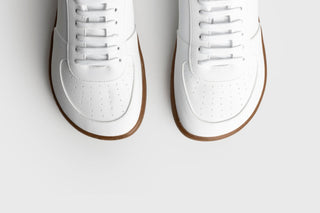
How to adapt your body to supportive footwear gradually, consciously and without complications:
If you've landed on barefitshoes.com, you probably already know what barefoot or eco-friendly footwear is. You might even have your first pair of minimalist shoes, or be about to. What comes next is just as important as choosing the right model: how to make a smooth transition so you can enjoy all the benefits from the very first step.
The good news is that it's not complicated or risky. You just need to know a few key principles and take the time to allow your body—and especially your feet—to adapt to a freer, more natural way of moving.
Why is a transition necessary?
Switching from conventional footwear to barefoot shoes involves changes. Most of us have spent years wearing shoes with rigid soles, raised heels, and narrow toe boxes. Barefoot shoes, by allowing the foot to move freely, activate muscles that haven't been working at 100% for a long time.
That doesn't mean you'll experience discomfort or that it will be difficult. It simply means your body will rediscover how to walk, support itself, and move naturally. Therefore, the transition isn't a barrier, but an opportunity to reconnect with your natural movement patterns.
Step by step: how to make a comfortable transition to barefoot walking.
1. Start with short uses, without rushing
You don't need to change all your shoes at once or spend eight hours a day barefoot from the start. Ideally:
- Wear your barefoot shoes for 30 to 60 minutes daily at first.
- Incorporate them into everyday activities such as short walks, moving around the house, or daily tasks.
- Gradually increase usage time as you become more comfortable.
Remember: progression is more important than speed. If you feel fatigue in the soles of your feet or calves one day, slow down a bit. It's completely normal during the first few days.
2. Alternate with your usual footwear if needed.
Many people transition by combining barefoot walking with their old shoes for the first few weeks. There's no single right way to do it. Spending some time barefoot and other times in conventional shoes (especially if you spend a lot of time on your feet or work on hard surfaces) is still real progress.
3. Practice conscious foot support
With barefoot running, the body naturally tends to adopt a softer, more controlled, and balanced gait. However, you can facilitate this adaptation by:
- You shorten your stride slightly.
- You place your foot down gradually (not "hitting" the heel).
- You keep your torso aligned and your body relaxed.
You don't need to force a technique: let your body find its own balance. Simply walk mindfully, and your gait will adjust on its own.
4. Reinforce the process with simple exercises
Although walking barefoot already activates the foot muscles, you can accelerate your adaptation with some basic exercises:
- Walk on your toes and then on your heels (a few meters a day).
- Separate and move your fingers (especially your thumb).
- Roll a ball under the sole of your foot for 1-2 minutes.
- Gentle stretches of the calves and Achilles tendon.
You don't need more than 5-10 minutes a day, and the results are noticeable.
5. Train barefoot (when you feel ready)
Once you can walk comfortably, you can introduce barefoot walking into gentle workouts:
- Yoga or mobility.
- Bodyweight strength exercises.
- Longer walks over natural terrain.
- Functional training or even running (if that's your goal, with an even more gradual progression).
👟 At barefitshoes.com you'll find perfect styles for everyday wear, as well as for moving around, training, or exploring. From urban sneakers to options for hiking or sports.
What if I notice something strange?
It's common to experience slight fatigue in your feet or legs during the first few days, especially if you've never used your foot muscles so much before. This isn't a sign that anything is wrong; it simply means your body is making a natural adjustment.
Simply listen to your body and adjust the usage time according to how you feel. You don't need to endure it or force it. The goal is for the transition to be pleasant, gradual, and personalized.
Real benefits of a well-executed transition
Those who make this transition with care and consistency often experience:
- More strength and mobility in the foot.
- Improved balance and body coordination.
- Fewer postural discomforts (knees, hips, back).
- Greater lightness and freedom of movement.
- A feeling of walking with confidence and a connection to the environment.
In short: taking the step to barefoot walking is returning to nature.
Adapting to barefoot footwear isn't complicated, and it's certainly not risky. It's a decision that benefits your body, your posture, and your long-term well-being.
With a gradual and conscious transition, the only thing you'll notice is a positive evolution in the way you walk, train, and move.
At barefitshoes.com we accompany you with comfortable, functional and carefully selected barefoot footwear for each stage of your transition.